
React.js vs Traditional Web Development
Understand the difference between React-based development and traditional website development and why component-based architecture is useful for modern applications.
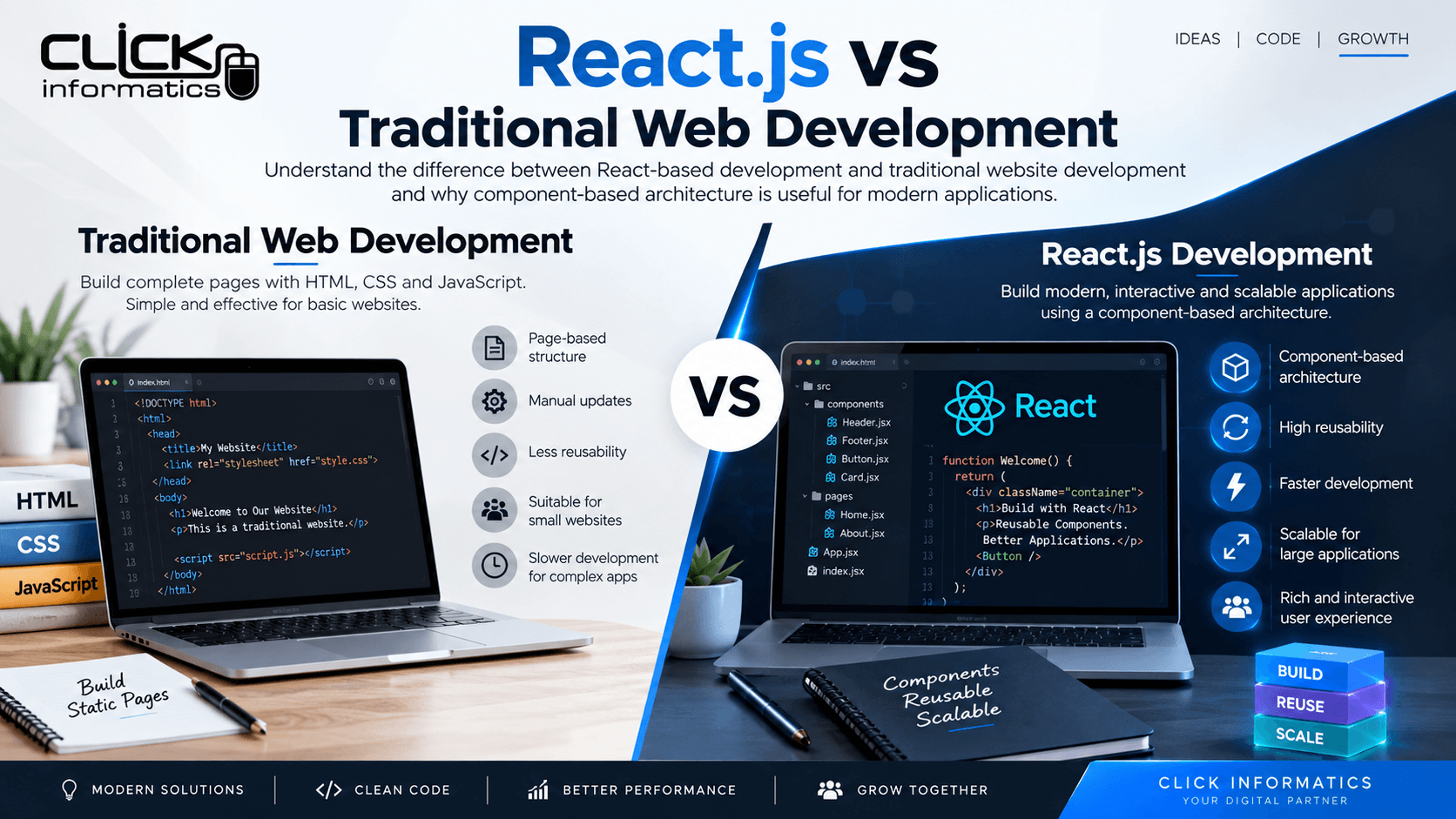
The Evolution of Web Development
Web development has changed significantly over the years. Traditional websites often relied heavily on individual HTML pages, while modern applications increasingly use component-based frameworks and libraries.
React.js is one of the technologies that changed the way developers build interactive web interfaces.
What Is React.js?
React.js is a JavaScript library used for building user interfaces. It allows developers to divide an interface into reusable components.
For example, a website can have reusable components for navigation, buttons, cards, forms, testimonials and other interface elements.
Traditional Web Development
Traditional website development commonly uses HTML, CSS and JavaScript to create web pages. This approach remains useful for many projects, particularly simple websites.
However, when an application becomes more interactive or contains many repeated interface elements, maintaining individual pages can become more difficult.
Why Component-Based Development Helps
React allows developers to create reusable components. Instead of repeatedly writing the same interface structure, a component can be created once and reused in different parts of the application.
Reusable Components
Reusable components can improve consistency across a website. If the same type of card or button is used throughout an application, changes can be managed centrally.
Interactive Interfaces
React is useful for applications where the interface needs to respond dynamically to user actions and changing data.
Better Project Organization
Component-based architecture can help developers organize large interfaces into smaller and easier-to-understand sections.
React for Business Applications
React can be useful for dashboards, customer portals, business tools, e-commerce interfaces and other applications where users interact with dynamic content.
At Click Informatics, React can be used as part of a modern frontend technology stack when it matches the requirements of the project.
React and Next.js
React focuses primarily on building user interfaces. Next.js extends React with additional capabilities for building complete web applications.
This combination can provide a strong foundation for modern business websites and applications.
Performance and User Experience
Modern users expect websites to respond quickly. A well-structured frontend can contribute to a smoother user experience.
However, performance does not depend on React alone. Images, APIs, backend services, hosting, database queries and application architecture also affect the final experience.
When Traditional Development Is Still Useful
Not every project needs React. A simple informational website may not require a complex frontend framework.
The right technology should therefore be selected according to the project's features, expected growth, budget and maintenance requirements.
Click Informatics Development Approach
Click Informatics evaluates the requirements of a project before selecting its technology stack. React and related technologies can be valuable when a project requires reusable components, dynamic interfaces and scalable frontend development.
Conclusion
React.js has become an important technology for modern frontend development. Its component-based approach can make complex interfaces easier to build and maintain.
The goal is not to use the newest technology simply because it is popular. The goal is to choose technology that solves the actual business problem.
Frequently Asked Questions
Is React better than HTML?
React and HTML serve different purposes. HTML is the foundation of web content, while React helps developers build dynamic component-based interfaces.
Can React be used for an e-commerce website?
Yes. React can be used to build interactive e-commerce interfaces and can work with backend services and APIs.
Does React improve website speed automatically?
No. Performance depends on the overall implementation, including code, assets, APIs, rendering strategy and hosting infrastructure.
Tags
Written by
Click Informatics Team
Engineering & Product Team
Blog
More articles you might like



Have a similar project in mind?
Tell us what you're building — we'll reply within one business day.
Start a project