
Building Scalable Applications with Node.js
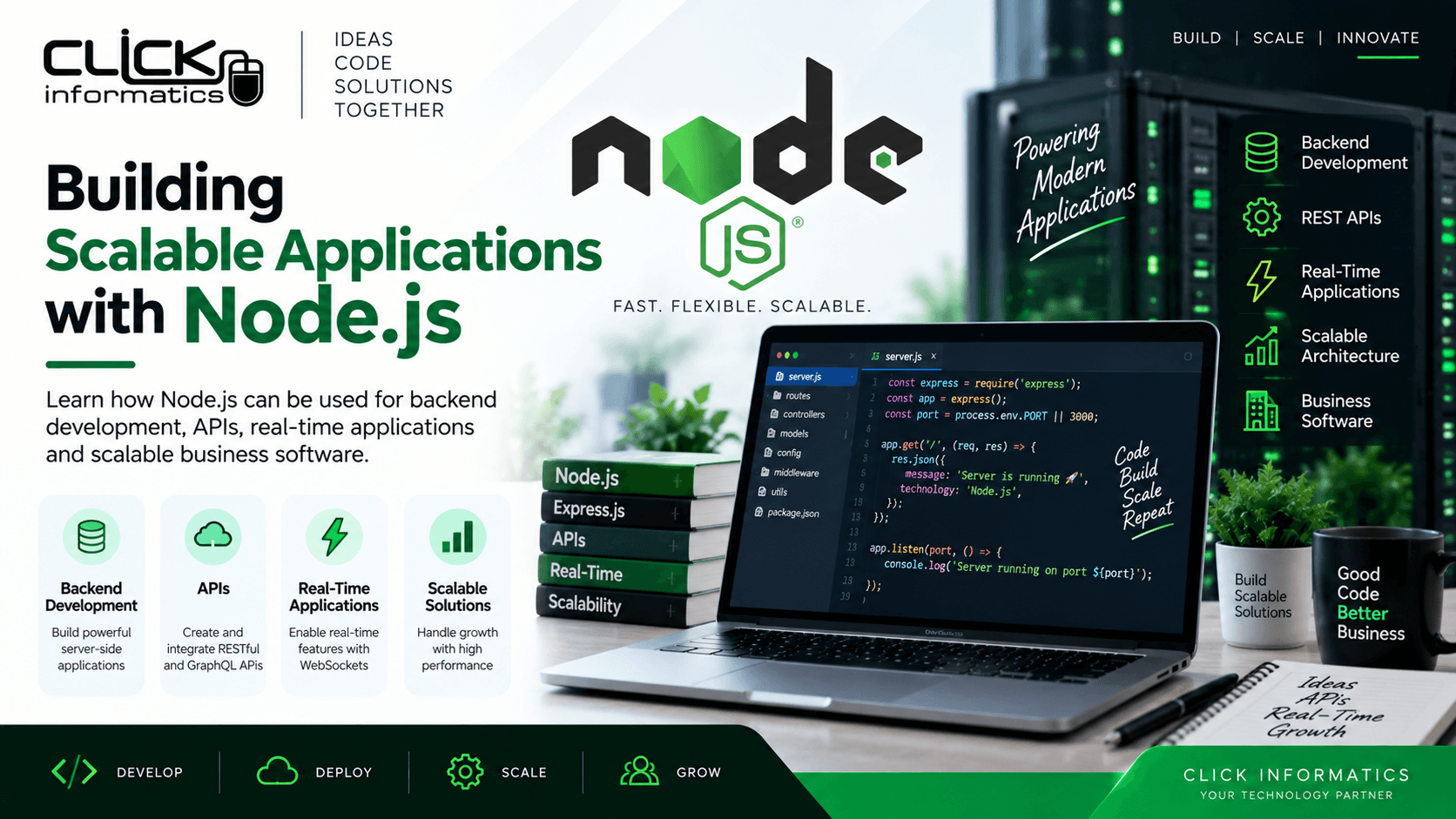
Learn how Node.js can be used for backend development, APIs, real-time applications and scalable business software.
Why Backend Technology Matters
A modern website or application often depends on much more than the visible interface. User accounts, databases, APIs, business logic, notifications and integrations usually require a backend system.
Node.js is one technology that can be used to build these backend services.
What Is Node.js?
Node.js is a JavaScript runtime that allows JavaScript to be used for server-side development.
This allows development teams to use JavaScript across different parts of an application and build backend services, APIs and other server-side functionality.
Why Node.js Is Useful
API Development
APIs are an important part of modern software. They allow frontend applications, mobile applications and external systems to communicate with backend services.
Node.js can be used to build APIs that handle application requests and communicate with databases and other services.
JavaScript Across the Application
When frontend and backend systems both use JavaScript-based technologies, teams can maintain a consistent development environment and share certain development concepts.
Scalable Architecture
Node.js can be used as part of architectures designed to support applications as they grow. The final scalability, however, depends on the complete system architecture rather than one technology.
Node.js for Business Applications
Businesses can require dashboards, customer portals, inventory systems, booking systems, e-commerce functionality and internal applications.
These applications often need reliable backend services to process information and connect different systems.
Node.js and Databases
Backend applications need a way to store and retrieve data. Node.js applications can communicate with databases through appropriate drivers, libraries and backend architecture.
The database should be selected according to the application's data structure, performance requirements and business needs.
Node.js and APIs
APIs can connect a Node.js backend with frontend applications, mobile applications, payment systems, CRM platforms, ERP systems and other services.
Proper authentication, authorization, validation and error handling are important when building production APIs.
Node.js and Real-Time Applications
Some applications require real-time communication. Depending on the architecture, Node.js can be used as part of systems that support real-time functionality such as notifications and live updates.
Security
Backend development must consider security from the beginning. Sensitive credentials should be protected, inputs should be validated and access to application resources should be controlled.
Click Informatics and Node.js
Click Informatics uses modern backend technologies according to project requirements. Node.js can be useful when a project requires API development, backend services or integration with modern frontend applications.
Conclusion
Node.js provides a practical environment for building modern backend applications and APIs. Combined with a suitable database, frontend and cloud infrastructure, it can form part of a scalable software solution.
Frequently Asked Questions
Is Node.js a programming language?
No. Node.js is a JavaScript runtime that allows JavaScript to run on the server.
Can Node.js be used for APIs?
Yes. Node.js is widely suitable for building backend APIs and services.
Can Node.js connect with PostgreSQL?
Yes. Node.js applications can communicate with PostgreSQL using suitable database drivers and application libraries.
Tags
Written by
Click Informatics Team
Engineering & Product Team
Blog
More articles you might like

Have a similar project in mind?
Tell us what you're building — we'll reply within one business day.
Start a project